
“This atlas should be considered essential reading for any clinician working with musculoskeletal pain.”
Despite their ubiquity, trigger points have long remained in the shadows of mainstream medicine: too complex to dismiss, yet too slippery to fully capture.
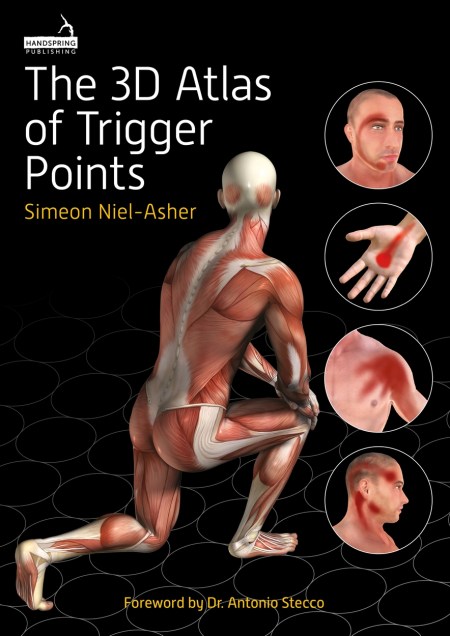
The 3D Atlas of Trigger Points brings clarity, integration, and visual precision to a field that has often lived in the margins between anatomy, neurology, and manual therapy. By combining historical context, cutting-edge research, and lived clinical expertise with innovative 3D visualization, this atlas offers both a practical guide to understanding, and a new way of visualizing pain of myofascial origin. The 3D Atlas of Trigger Points explains why trigger points form in predictable places, why their referral patterns make sense, and why treating them restores not only individual muscles but entire movement systems.
This book is an essential tool for clinicians, helping them locate, understand, and treat pain more effectively.
Despite their ubiquity, trigger points have long remained in the shadows of mainstream medicine: too complex to dismiss, yet too slippery to fully capture.
The 3D Atlas of Trigger Points brings clarity, integration, and visual precision to a field that has often lived in the margins between anatomy, neurology, and manual therapy. By combining historical context, cutting-edge research, and lived clinical expertise with innovative 3D visualization, this atlas offers both a practical guide to understanding, and a new way of visualizing pain of myofascial origin. The 3D Atlas of Trigger Points explains why trigger points form in predictable places, why their referral patterns make sense, and why treating them restores not only individual muscles but entire movement systems.
This book is an essential tool for clinicians, helping them locate, understand, and treat pain more effectively.
Reviews
What stood out to me most about this book is its visual clarity. It presents muscular anatomy and pain patterns in a way that is easy to follow, and I think it will be a useful clinical reference for many practitioners.
Simeon Niel-Asher's The 3D Atlas of Trigger Points integrates diverse, multidisciplinary perspectives from the field of myofascial pain, from neurophysiology and embryology to fascial mechanics, biochemistry, nutrition, and the gut-muscle axis. By weaving these ideas into a systems-level framework, the book also highlights the many outstanding gaps in our understanding of the neurobiological mechanisms driving the pathophysiology and phenotypic heterogeneity of this complex condition. With its innovative 3D visualizations and practical clinical approach, this atlas is an essential addition to any clinician's library.
The 3D Atlas of Trigger Points by Simeon Niel-Asher offers a clear and clinically relevant perspective on myofascial pain. The integration of anatomical detail with three-dimensional pain mapping supports both diagnostic reasoning and practical application.
From my perspective as an osteopathic clinician, teacher, and researcher-but equally relevant far beyond it-this atlas should be considered essential reading for any clinician working with musculoskeletal pain.
Simeon Niel-Asher expertly bridges complex pain science with exceptional visual clarity. His dedication to clinical precision provides an invaluable, highly practical resource that will significantly enhance any manual & musculoskeletal therapist's daily practice.
Niel-Asher's 3D Atlas of Trigger Points is a most welcome addition to the library on the diagnosis and treatment of myofascial pain. It has an easy-breezy feel to it, with a good introductory section (Part 1) followed by an excellent Atlas (Part2). It also incorporates an interesting approach to myofascial pain- with the muscles and the fascial and nervous structures discussed.
Part 1 includes chapters on the general approach taken by the author and additional pleasing chapters on the history of myofascial pain, normal muscle physiology and myofascial pain development, as well as discussions on biochemical, nutritional and microbiome factors. Probably not intended to be exhaustive, Part 1 is a good introduction to this field.
Part 2 is basically a good review of muscle pain patterns. Each chapter outlines the anatomy, function and examination of the muscles. Pain patterns are displayed and additional clinical information provided. The general layout and display are very easy on the eye- making this part a pleasant reference.
In summary- an excellent tome, up to date and including all the information that the novice and experienced practitioner can utilize. It can take a proud place on the bookshelf of myofascial pain. Neil-Asher is to be commended for this book- a 3D Atlas of Trigger Points.
This book stands at the intersection of tradition and innovation. It honors the foundational work on trigger points while integrating emerging insights from fascial research. It challenges reductionist thinking and encourages a systems-based approach, one that recognizes the body as an interconnected continuum rather than a collection of discrete parts.
For clinicians, therapists, and students alike, the ideas presented here offer both a conceptual framework and a practical guide. More importantly, they invite curiosity: to question established models, to observe more closely, and to treat with greater precision and understanding.